Outlet Not Working? Troubleshoot It Before You Call
— Category: Home Electrical Safety
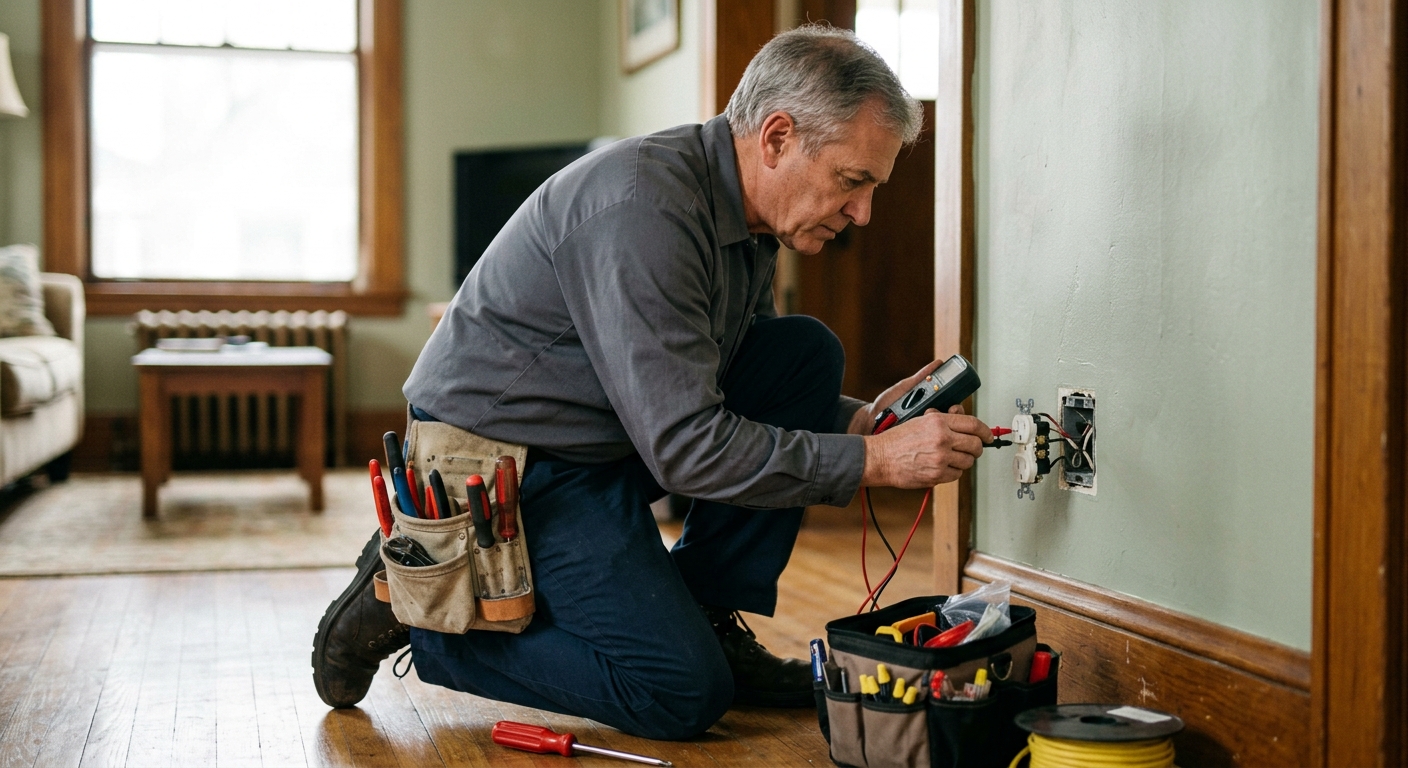
Your outlet stopped working and you want it back. Before you call anyone, there are three things worth checking, and two of them take under a minute. Here is the part most guides skip: an outlet that goes dead while the breaker stays on is telling you something specific. Sometimes it means a GFCI upstream did its job. Sometimes it means a connection behind the wall is failing, and that second case is the one you do not want to ignore. Norske Electric has been diagnosing dead outlets across the Minneapolis metro for 18 years, and we would rather you fix the easy ones yourself than pay us to press a reset button.
We will walk the safe checks first, fastest fix first, then draw a clear line at the point where a dead outlet becomes an electrician's job. If at any point you smell burning plastic or see scorch marks, stop reading and call (952) 443-4113.
Outlet Not Working: The Three Checks to Run First
Start with the checks that cost nothing and rule out the most common causes. About seven out of ten dead-outlet calls we get in the Twin Cities trace back to one of these three, and the first two you can clear yourself in five minutes.
1. Find and reset the GFCI. A single tripped GFCI can kill several outlets downstream of it, often in a different room. Walk your bathrooms, kitchen, garage, basement, and any exterior walls, and press RESET firmly on every GFCI outlet you find. If one clicks and holds, you are done.
2. Check the breaker panel. Look for a breaker that is fully off, or one sitting halfway between on and off. Push it all the way to OFF first, then firmly back to ON. A breaker that will not stay reset is a separate problem, covered below.
3. Test the wall switch. Some outlets are half-hot, meaning one half is controlled by a wall switch. If a lamp on that outlet died, a flipped switch may be the whole story.
If all three checks come up empty and the outlet is still dead, you have ruled out the easy fixes. That is useful information, not a dead end. Read on.
Why Did My Outlet Stop Working But the Breaker Didn't Trip?
This is the question that separates a quick fix from a real problem, so here is the direct answer. A breaker trips on overload or a short. A single dead outlet with the breaker still on almost always means the fault is local to that outlet or the wiring feeding it, not the whole circuit. The three usual causes are a tripped GFCI upstream, a failed connection inside the outlet box, or a break in the wire between that outlet and the last working one on the circuit.
The GFCI cause is the good one, and it is worth understanding how it spreads. When a GFCI is wired through its LOAD terminals, one tripped device takes out every outlet fed downstream of it. We wrote a full breakdown of how GFCI line vs load wiring affects downstream outlets if you want to trace the chain yourself.
"A dead outlet with a live breaker is not random. It is pointing you at one box or one connection. The trick is deciding whether that box is safe for you to open."
The failed-connection cause is the one to respect. Over years of service the connections inside an outlet loosen, especially the push-in "backstab" connections common in 1990s and early-2000s builder-grade Twin Cities homes. A loose backstab arcs, heats up, and eventually stops conducting. The outlet goes dead. What you cannot see from the front is whether that connection has been quietly cooking the plastic behind it.
When a Half-Hot or Switched Outlet Is the Whole Answer
Before you assume the worst, rule out the simplest wiring quirk in the house. A half-hot outlet, also called a switched outlet, has one receptacle always live and the other controlled by a wall switch, usually so a lamp can be turned on from the doorway. If only the top or only the bottom of an outlet is dead, and a nearby switch does nothing obvious, you likely have a switched outlet with the switch off.
• Flip every switch in the room, one at a time, and re-test the outlet after each.
• Test both halves of the outlet separately with a lamp or phone charger.
• Check for a switch that lost its own connection, which behaves the same as an off switch.
This is a nuisance, not a hazard, and no electrician is required. If the switch itself feels loose, buzzes, or is warm, that is different, and it belongs in the call-us column below. Non-urgent and want it handled properly? Request an outlet or switch repair and we will schedule around you.
GFCI Outlet Not Working in a Minneapolis Home
GFCI outlets have a real service life, and this is where a lot of Minneapolis homeowners get stuck. Leviton and most major brands rate their GFCIs for roughly 10 years. After that the internal sensor can degrade, and the outlet may refuse to reset no matter how firmly you press the button. A GFCI that will not reset after you have confirmed power is reaching it has usually reached end of life and needs replacement, not more troubleshooting.
There is one more twist. In damp locations, an outdoor or garage GFCI can trip because it is actually detecting moisture, which is the device doing exactly what it should. Dry the area, let it sit, then reset. If it trips again immediately with nothing plugged in, the wiring or the device needs a look. Not sure which? A licensed tech can settle it fast, so call (952) 443-4113 and we will talk it through.
When to Call an Electrician for a Dead Outlet
Here is the honest line, including the part that could cost us the reset-button call. Do not call us for a dead outlet if you have not yet checked the GFCIs and the breaker, or if a flipped wall switch turns out to be the answer. Those are five-minute fixes, and you should keep your money. Check the obvious first.
Now the other side. Stop what you are doing and call a licensed electrician if any of these are true:
• You see scorch marks, melted plastic, or discoloration on or around the outlet.
• You smell burning or a fishy, acrid odor near the outlet or the panel.
• The outlet or its cover plate is warm or hot to the touch.
• The breaker trips again immediately every time you reset it.
• Your home was built before about 1972 and may have aluminum branch wiring, which fails at connections and is a known fire risk.
• You would have to open the box and you are not certain the circuit is de-energized.
That aluminum-wiring point is worth dwelling on for anyone in older Twin Cities housing stock. Homes built in that window often used aluminum for branch circuits. Aluminum expands and contracts more than copper, so its connections loosen over time, arc, and overheat, exactly the pattern behind a dead outlet that is also warm. If that describes your home, do not treat a dead outlet as a simple swap.
What a Proper Diagnosis Looks Like
When we take a dead-outlet call, we do not just replace the receptacle and leave. Here is the sequence, so you know what you are paying for.
1. Confirm the circuit at the panel and identify every outlet fed by it, including any GFCI in the chain.
2. De-energize and open the box to inspect the connections, looking for backstab failures, loose screws, heat damage, and wire condition.
3. Test for aluminum branch wiring in homes from the era where it was used, because the fix differs entirely.
4. Repair or replace the failed device or connection, using proper terminations rather than the push-in backstabs that caused the problem.
5. Re-test the whole circuit, not just the one outlet, so a hidden second bad connection does not surface next month.
If the checks at the top of this article did not bring your outlet back, that usually means the fault is inside a box, and that is our line of work. You can read more about our approach to electrical troubleshooting service, or skip straight to a fix.
Bottom Line
A dead outlet is worth five minutes of your own time before it is worth a phone call. Reset the GFCIs, check the panel, test the wall switch. If those bring it back, you are done and you owe nobody anything. If the outlet stays dead with the breaker on, the fault is almost certainly inside a box, and if it is warm, scorched, or in an aluminum-wired home, it is a safety issue, not an inconvenience. Norske Electric, owned by Brevik Tharaldson and licensed in Minnesota (MN Lic #EA005268), has handled outlet and switch repair in the Twin Cities for 18 years from offices in Hamel and Savage. When the easy checks do not work, call (952) 443-4113 and we will find the actual fault.