Which Way Should a Ceiling Fan Spin? Summer vs Winter
Updated
— Category: Home Comfort & Energy
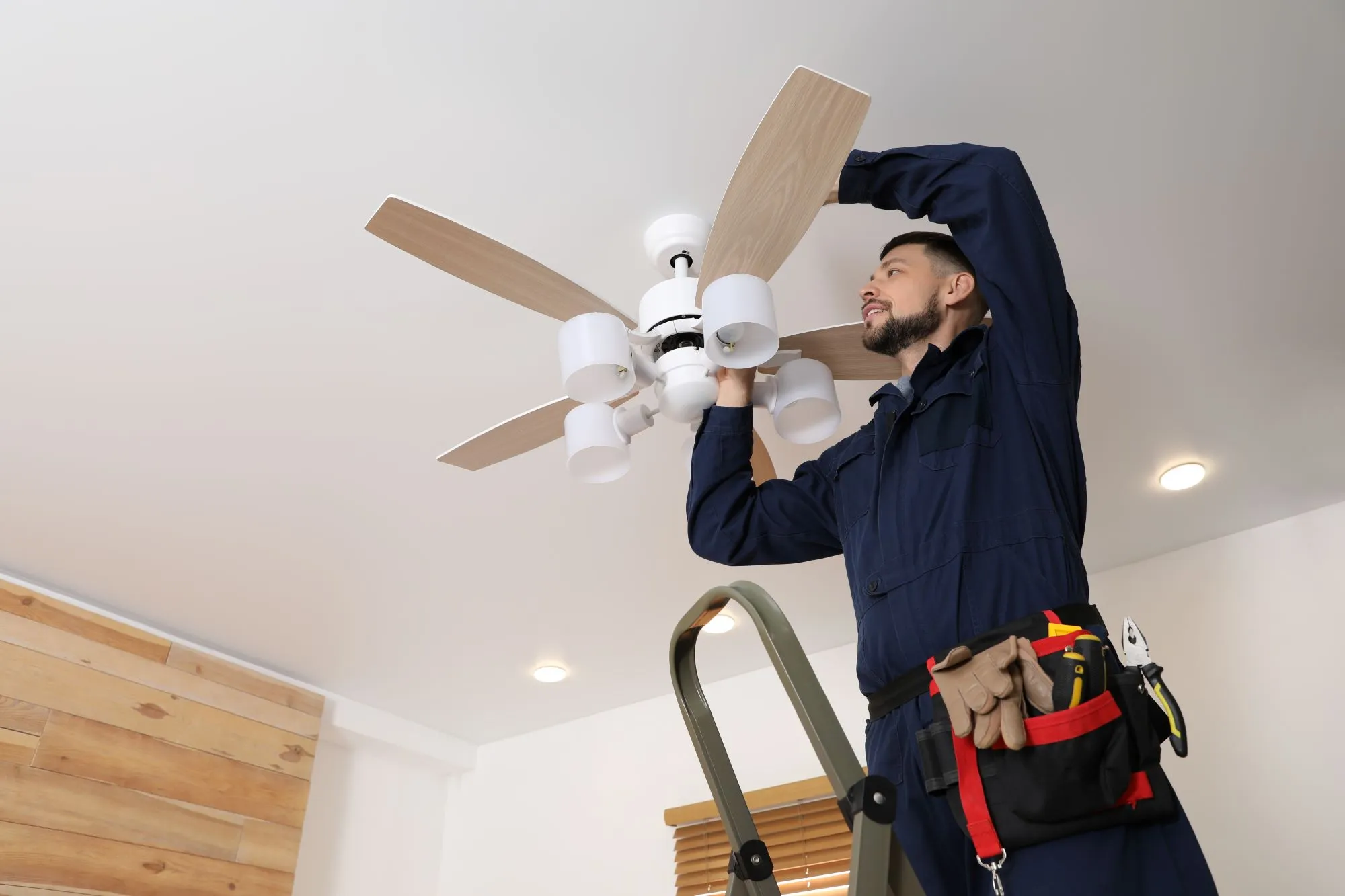
Your ceiling fan has a switch most people never touch, and it is doing half the work of your fan wrong for half the year. In summer the blades should spin counterclockwise to push a breeze straight down at you. In winter they should spin clockwise on low to pull warm air off the ceiling and mix it back into the room. Same fan, opposite jobs, one small switch on the motor housing. Get it right and a fan that uses roughly one percent of the electricity your air conditioner draws lets you nudge the thermostat a few degrees in either direction. This guide walks through which way to set it for each season, how to actually flip the direction, and the three warning signs that mean the fan needs an electrician rather than a switch flip. If your fan wobbles, has no reverse switch, or the ceiling box feels loose, skip to the bottom, that is an install or repair, not a setting.
Norske Electric has installed and balanced ceiling fans across the Twin Cities for 18 years, from 1950s Nokomis ramblers with 8-foot ceilings to newer Maple Grove split-levels with vaulted great rooms. The direction rule is the same everywhere. The right fan and a solid mount are what actually make it work.
Which Direction Should a Ceiling Fan Spin in Summer?
In summer, set the fan to spin counterclockwise when you look up at it, on medium or high. Counterclockwise blades push air straight down, and that column of moving air evaporates the thin layer of moisture on your skin, which is what makes you feel cooler. The room does not actually get colder, you just feel three to four degrees cooler standing in the breeze. That lets you raise the thermostat and run the air conditioner less during a humid Minnesota July.
There is a catch worth knowing. A ceiling fan does nothing for a room nobody is standing in. It moves air, it does not lower the actual temperature, so leaving fans running in empty bedrooms all day just adds heat from the motor and wastes power. Run the fan when the room is occupied, turn it off when it is not, and let the counterclockwise breeze do the work while you are there.
Which Direction Should a Ceiling Fan Spin in Winter?
In winter, reverse the fan to spin clockwise on the lowest speed. Warm air rises and stacks against the ceiling, which is wasted heat in a room where you live down at floor level. Clockwise blades on low pull cool air up through the center and push the trapped warm air gently down the walls, mixing it back into the room without creating a chilly draft. Done right you feel no breeze at all, you just notice the room holding heat more evenly.
"In a Twin Cities home with a vaulted ceiling, winter heat piles up ten feet over your head where it does you no good. A fan on clockwise low is the cheapest way we know to get that heat back down to where you actually sit."
Low speed is the whole trick here. Crank a clockwise fan to high in January and you create exactly the downdraft you were trying to avoid, which makes the room feel colder and sends people reaching for the thermostat. This matters most in the tall spaces common in Minnesota builds: vaulted great rooms, open stairwells, and finished basements with the furnace nearby. Those are the rooms where the ceiling-to-floor temperature gap is widest, and where clockwise-on-low earns its keep. Set it, leave it, and the fan works quietly in the background all winter.
How Do I Tell Which Way My Fan Is Spinning?
Stand directly under the running fan and watch the blades. Counterclockwise, the leading edge of each blade rotates from your right toward your left across the top, and you feel air pushing down on you. That is summer. Clockwise is the reverse, and you should feel little to no breeze standing under it. That is winter. If you feel a strong breeze in winter or almost none in summer, the direction is backward for the season.
The reverse control is usually one of three things:
• A small toggle switch on the motor housing, just below the blades. Turn the fan off, wait for the blades to stop completely, flip the switch, and turn it back on.
• A button on the remote, often labeled with a reverse or fan-direction icon, on newer fans.
• A setting in the wall control or app, on smart and DC-motor fans installed in the last several years.
Twice a year is the rhythm. Flip it counterclockwise when you swap the storm windows for screens in spring, and clockwise when you turn the furnace back on in fall. Tie it to something you already do seasonally and you will never forget which way it should be running.
When the Fan Is the Problem, Not the Setting
Here is the honest part. Direction only helps if the fan itself is sound and mounted right. Three problems turn a fan from a comfort upgrade into a hazard, and none of them are fixed by a switch. First, a fan that wobbles under normal speed. A little shimmy can be a bent blade or a balancing issue, but a heavy wobble usually means the fan is hung from a box that was never rated to carry a moving load. Second, an older fan with no reverse switch at all, which means you are stuck with one direction year round and losing the winter benefit entirely. Third, a fan mounted to a standard light-fixture box rather than a fan-rated box, which is a real safety problem because standard boxes are not built for the constant vibration of a spinning fan.
"We see it constantly in older Twin Cities homes: a fan screwed into the same round box the builder used for a light fixture in 1985. That box was never rated for a fan's weight and motion. It is the number one reason we get called out to a fan that wobbles or sags."
If any of those three describe your fan, that is an install or repair job. A fan-rated box, a properly braced mount between the ceiling joists, and a balanced set of blades are the difference between a fan that runs quietly for fifteen years and one that rattles loose. This is genuinely worth a call: see how we install and balance ceiling fans, or call (952) 443-4113 if yours wobbles.
When you do not need to call us
We will say the part most contractors skip. If your fan spins smoothly, has a working reverse switch, and is quiet, you do not need an electrician, you need to flip the switch twice a year and move on. Do not let anyone talk you into replacing a perfectly good, properly mounted fan just to get a fancier remote. The reasons to actually call are a wobble, a missing reverse switch, a fan on a non-rated box, or a new install where none exists today. Everything else is a two-second seasonal habit.
Ceiling Fan Direction FAQ
My ceiling fan is on but the room is not cooling. Why?
A ceiling fan cools people, not the air, so it does nothing for an empty room and it never lowers the actual temperature the way an air conditioner does. First check the direction: in summer the blades must spin counterclockwise to push a breeze down on you. If it is set to clockwise, you will feel almost no air movement and no cooling. Also make sure you are standing in the fan's path, and turn it off when you leave the room. If the direction is right and the fan still barely moves air, the motor or capacitor may be failing, which is a repair. Norske Electric handles that across the Minneapolis metro.
How do I reverse a ceiling fan for winter?
Turn the fan off and wait for the blades to stop completely. On most fans there is a small toggle switch on the motor housing just under the blades, flip it to change direction. Newer fans use a reverse button on the remote, and smart or DC-motor fans use a wall control or app setting. Set it to clockwise, then run the fan on its lowest speed so it pulls warm ceiling air down without creating a draft. If your fan has no reverse switch anywhere, it is an older single-direction unit, and upgrading to a reversible fan is worth it for the winter benefit alone.
Does running a ceiling fan actually save money in Minnesota?
Yes, in occupied rooms. A ceiling fan uses about one percent of the electricity a central air conditioner draws, so running it lets you raise your summer thermostat setpoint a couple degrees while still feeling comfortable, and in winter a clockwise fan on low mixes trapped ceiling heat back down so the furnace cycles less. The savings only show up in rooms you are actually in, though. Fans running in empty rooms waste power and add a little motor heat, so the real money-saver is using them where you are and shutting them off where you are not.
Bottom Line
Counterclockwise in summer to push a cooling breeze down, clockwise on low in winter to pull warm air off the ceiling, flipped twice a year with the seasons. That one switch, used right, lets a fan that sips power do real work against your heating and cooling bills, especially in the vaulted rooms common across Twin Cities homes. The setting is free and takes two seconds. The time to call a licensed electrician is when the fan wobbles, has no reverse switch, or is hanging from a box that was never rated for it. Norske Electric, owned by Brevik Tharaldson and licensed in Minnesota (MN Lic #EA005268), has installed and balanced ceiling fans for 18 years from offices in Hamel and Savage. See our ceiling and bathroom fan installation, find electricians serving Minneapolis homes, or call (952) 443-4113 to get a wobbling or missing fan handled right.