Ceiling Fan Where There's No Wiring: Do You Need an Electrician?
Updated
— Category: Home Comfort & Energy
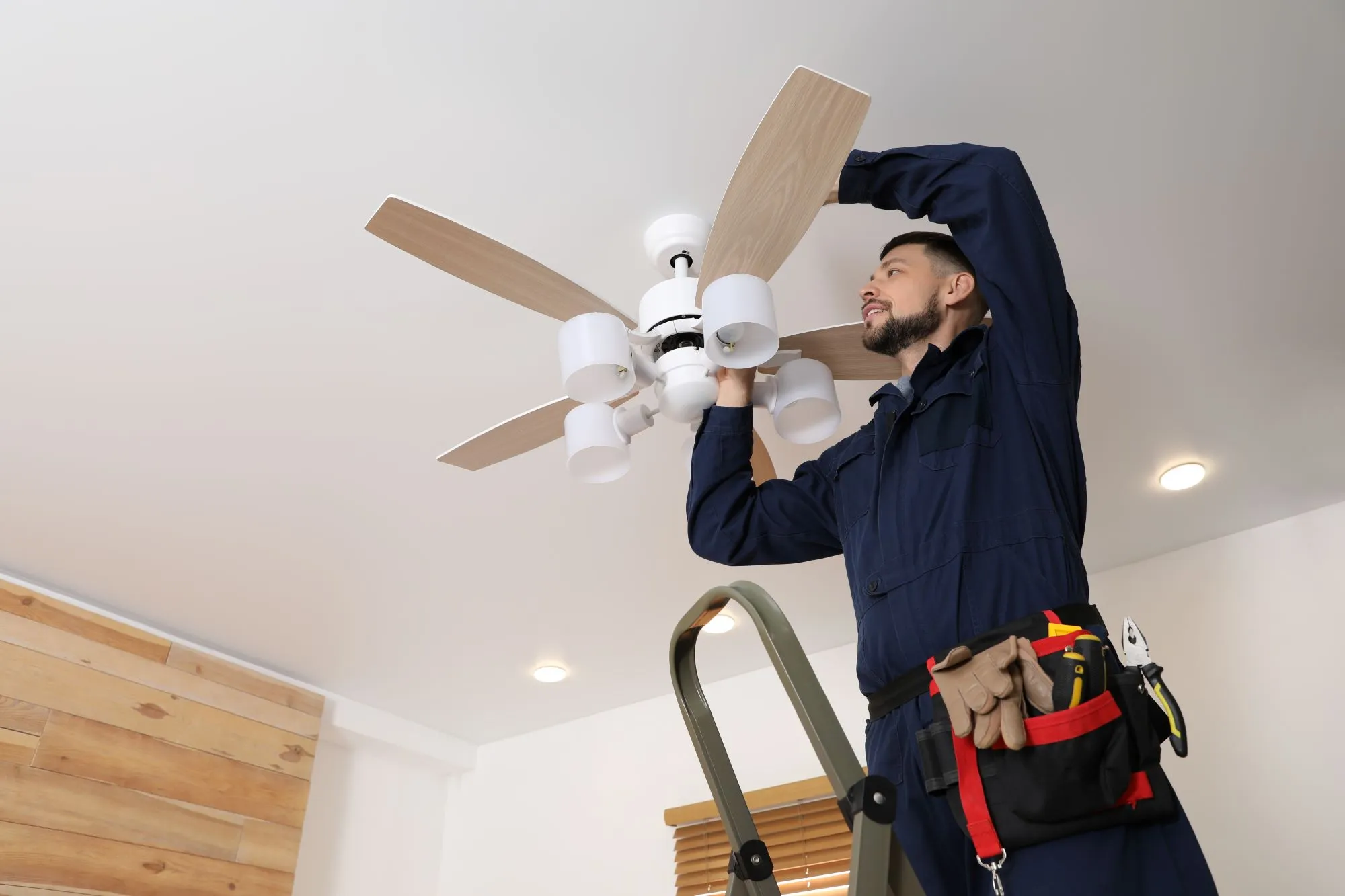
You want a fan on a ceiling that has nothing up there right now. No light, no box, no wire, no wall switch. That's the job people underestimate, because it isn't a fan install, it's a small wiring project with a fan bolted on at the end. Swapping a fan for an existing light is a weekend task most handy homeowners can pull off. Running power and a switch to a bare ceiling, cutting into a finished room, and hanging a spinning 20-pound load overhead is a different animal, and in most Minnesota homes it lands squarely in electrician territory. This guide walks through the no-wiring case honestly: what the work involves, why the electrical box is the part that actually matters, when you legitimately can do it yourself, and the point where you shouldn't.
Norske Electric has installed ceiling fans across the Twin Cities for 18 years, from 1920s South Minneapolis bungalows with plaster ceilings and no attic access to newer Lakeville builds with open trusses overhead. The house you have decides how hard the wire run is. That's the first thing we look at before we quote anything.
How Do You Install a Ceiling Fan Where There Is No Wiring?
The short answer: you run a new power feed to the ceiling, cut in a fan-rated support box, run a switch leg down to a wall, and only then hang the fan. In a home with open attic space above the room, that's a manageable half-day job. In a room with a finished ceiling above it, a second story, or plaster-and-lath, it turns into fishing wire through closed cavities and patching, which is where the hours and the cost climb.
Here's the actual sequence a licensed electrician follows on a from-scratch install:
1. Plan the circuit. We confirm which circuit can take the load and where the switch will live, then map the shortest safe wire path from a power source to the ceiling location.
2. Cut in the box. A fan-rated box gets mounted to solid framing at the exact center point, braced so it carries a moving load, not just a static one.
3. Run the power feed. New cable runs from the source to the ceiling box, through the attic when there's access, or fished through walls and ceiling cavities when there isn't.
4. Run the switch leg. A second cable drops down inside the wall to a new switch box so the fan (and its light, if it has one) is wall-controlled, not just pull-chain.
5. Mount and balance the fan. The fan hangs off the rated box, gets wired, and gets balanced so it runs without wobble.
6. Test and inspect. We verify the circuit, confirm the switch controls the right functions, and pull a permit where the local jurisdiction requires one.
Older Minneapolis and St. Paul homes complicate step 3 the most. Plaster-and-lath ceilings don't cut cleanly like drywall, balloon-framed walls can lack the fire blocking that makes wire-fishing predictable, and a lot of pre-1970 rooms have no nearby circuit with capacity to spare. None of that stops the job. It just means the person doing it needs to know how these houses are built.
Do I Need an Electrician to Install a Ceiling Fan?
For a straight swap where a fan-rated box and a switch already exist, a confident homeowner can usually handle it. For a no-wiring install, yes, you almost always need a licensed electrician, because the job involves running new circuits, cutting into finished surfaces, and code-compliant support for a moving overhead load. The difference isn't skill with a screwdriver, it's whether you're working with wiring that already exists or creating it from nothing.
The line is cleaner than most people expect. You're likely fine on your own when all of these are true:
• There's already a ceiling box in the spot you want the fan.
• That box is fan-rated (more on that below), not a standard light box.
• A wall switch already controls that location.
• You're comfortable working with the power off and verified dead.
You should call a licensed electrician when any of these are true:
• There's no box, no wire, or no switch at the location (the whole point of this article).
• The existing box is a standard light box, not fan-rated.
• The circuit is already loaded and you're not sure it can take a fan.
• You'd be cutting into plaster, a finished ceiling, or a second-story floor to run cable.
"The fan itself is the easy part. What we get called for is the wire that isn't there yet and the box that can't hold the weight. That's the work, and it's the work that has to be right."
When You Should NOT Add a Fan Here
Honest counsel, because it saves you money: don't force a ceiling fan into a room with a low ceiling. Code and manufacturers want at least 7 feet of clearance from the floor to the blades, and blades should sit roughly 8 to 10 inches below the ceiling to move air well. If your Minnesota basement or a 1940s upper bedroom has 7-foot-6 ceilings, a standard fan leaves too little headroom and moves almost no air on a flush mount. In that case a low-profile hugger fan or simply a better light fixture is the smarter call, and we'll tell you that before we take the job rather than after. Adding a fan that can't clear a head or barely stirs the air isn't a win for anyone.
Ready to find out what your room actually needs? Call (952) 443-4113 and we'll tell you straight whether it's a swap or a wiring job.
What Is a Fan-Rated Electrical Box, and Why Do I Need One?
A fan-rated box is a metal ceiling box specifically listed to carry a moving, vibrating load, and code requires one for any ceiling fan. A standard light box is built to hold a few pounds of static fixture. A ceiling fan can weigh 15 to 50 pounds and, more importantly, it moves, and that constant vibration works an ordinary box loose over time. This is the single most common mistake we find on other people's installs.
The difference matters because failure here is the dangerous kind:
• A standard box is often just nailed to the side of a joist and rated for around 6 to 10 pounds of dead weight. Hang a fan on it and vibration slowly pulls it free.
• A fan-rated box is UL-listed for fan use, marked as such, and secured either directly to framing or to an expanding brace bar rated for the moving load.
• The failure mode is a fan that literally drops out of the ceiling months or years later, which is exactly what the rating exists to prevent.
On a no-wiring install this is baked in, because we're cutting in a fresh box anyway and we use a fan-rated one every time. Where it bites homeowners is the DIY swap: pulling down an old light, seeing a box up there, and assuming it'll do. It usually won't. If you're doing your own swap and the box isn't marked for fan use, that's the moment to bring in professional ceiling fan installation across the Twin Cities rather than hoping the old box holds.
Adding the Wall Switch
Most people who add a fan from scratch want it controlled from the wall, not just a pull chain in the dark. That means a switch leg: a cable running from the fan's ceiling box down inside the wall to a new switch box. If you want the fan and its light on separate switches, that's a three-conductor run so each is controlled independently. Doing this cleanly on an existing finished wall is its own fishing job, and it's why adding a wall switch to control the fan is usually planned alongside the fan install rather than bolted on afterward.
Skipping the switch to save an hour is a false economy. Retrofitting one later means opening the wall a second time. If you're doing this once, do the switch leg while the cavity is already open.
Get a quote online and we'll scope the switch and the fan together so it's one clean job.FAQ: Ceiling Fan Installation With No Existing Wiring
Can I replace a light fixture with a ceiling fan?Yes, and it's the easier version of this job because the wire and switch already exist. The catch is the box: a fan needs a fan-rated support box, and most light fixtures hang on standard light boxes that aren't built for a moving load. Before you hang the fan, confirm the existing box is marked for fan use. If it isn't, it has to be swapped for a fan-rated one, which on a finished ceiling often means bringing in an electrician even for what looked like a simple upgrade.
How much does it cost to add a ceiling fan where there's no wiring?It depends almost entirely on ceiling access, not the fan. A ground-floor room with an open attic above is a short run and a modest job. A room with a finished floor above it means fishing cable through a closed cavity and patching, which takes more time. We quote after we see the room, because the wire path is what sets the price, not the fan on the box.
Do I need a permit to install a ceiling fan in Minnesota?A straight fan-for-fixture swap generally doesn't. Running a new circuit or a new switch leg is new wiring, and that typically does require a permit and inspection depending on your city. A licensed electrician pulls the permit as part of the job, so the work is inspected and on record, which matters when you sell.
Can a handyman install a ceiling fan?For a swap onto an existing fan-rated box with an existing switch, often yes. For a from-scratch install that runs new power and a new switch through your walls, that's licensed electrical work in Minnesota, and it should be done by a licensed electrician so it's to code and safe to live under.
When to Call Norske Electric
If your ceiling has nothing up there yet, the honest framing is this: you're not buying a fan install, you're buying a small wiring project that ends with a fan. The fan is the cheap part. The wire path, the fan-rated box, and the switch leg are the work, and they're the parts that have to be right so nothing comes loose or overloads a circuit down the line. Norske Electric, owned by Brevik Tharaldson and licensed in Minnesota (MN Lic #EA005268), has run new fan circuits in Twin Cities homes for 18 years, from plaster-ceiling bungalows to open-truss new builds, out of offices in Hamel and Savage. We'll look at the room, tell you honestly whether it's a swap or a wiring job, and quote the real path, not a guess. Call (952) 443-4113 or request a quote online and we'll get a fan where you actually want it.